Østerlars Kirke

Østerlars rundkirke
Østerlars Kirke

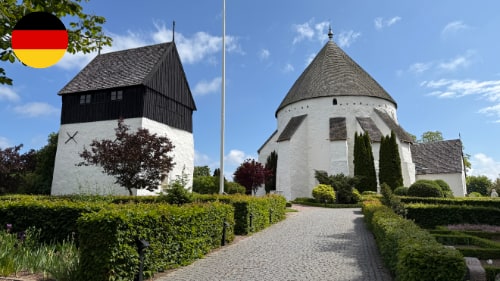
Østerlars Church stands on a hill north of the village of Østerlars and serves both as the parish church for Østerlarsker Parish and as one of Bornholm’s most visited historic church sites. It is the largest of the island’s four round churches and is considered the oldest. The church was built around the mid-12th century, during a period marked by power struggles between church and crown and occasional external threats, which may have influenced its design and function.

The round church is constructed with massive walls of Bornholm granite, more than two metres thick, and stands high in the landscape with views toward the coast. Inside the masonry is an internal staircase leading to the upper storeys, and the church once had a clear defensive character alongside its role as a parish church. Northeast of the church, archaeological excavations at Agerbygård have revealed a rich settlement from the Iron Age and Viking Age, showing that the site held significance long before the present church was built.

Inside, the central pillar is decorated with a continuous frieze of frescoes. These paintings date from the 14th century, were whitewashed after the Reformation, and rediscovered in 1889. They have since undergone several restorations and depict the life of Jesus in images from birth to resurrection. The altarpiece dates from around 1600; it was removed for a period and stored at the National Museum before being returned to Østerlars in 1956. It is now adorned with paintings by Paul Høm, while older inscriptions in the frame have been preserved. The baptismal font is Romanesque and probably as old as the church itself. It originally stood in Rø Church and was moved here during a major restoration in the 1950s.

Three runestones are associated with Østerlars Church: one stands outside the porch, one inside it, and one is built into the wall above the north door. The stones date from the 11th century and bear Christian runic inscriptions, reflecting the transition to Christianity on Bornholm. The church is dedicated to Saint Lawrence, one of the most widespread medieval saints, and its name is derived from his. Today, Østerlars Church functions both as an active parish church with services and ceremonies and as a significant historical and architectural landmark on Bornholm.


Østerlars Church stands on a hill north of the village of Østerlars and serves both as the parish church for Østerlarsker Parish and as one of Bornholm’s most visited historic church sites. It is the largest of the island’s four round churches and is considered the oldest. The church was built around the mid-12th century, during a period marked by power struggles between church and crown and occasional external threats, which may have influenced its design and function.

The round church is constructed with massive walls of Bornholm granite, more than two metres thick, and stands high in the landscape with views toward the coast. Inside the masonry is an internal staircase leading to the upper storeys, and the church once had a clear defensive character alongside its role as a parish church. Northeast of the church, archaeological excavations at Agerbygård have revealed a rich settlement from the Iron Age and Viking Age, showing that the site held significance long before the present church was built.

Inside, the central pillar is decorated with a continuous frieze of frescoes. These paintings date from the 14th century, were whitewashed after the Reformation, and rediscovered in 1889. They have since undergone several restorations and depict the life of Jesus in images from birth to resurrection. The altarpiece dates from around 1600; it was removed for a period and stored at the National Museum before being returned to Østerlars in 1956. It is now adorned with paintings by Paul Høm, while older inscriptions in the frame have been preserved. The baptismal font is Romanesque and probably as old as the church itself. It originally stood in Rø Church and was moved here during a major restoration in the 1950s.

Three runestones are associated with Østerlars Church: one stands outside the porch, one inside it, and one is built into the wall above the north door. The stones date from the 11th century and bear Christian runic inscriptions, reflecting the transition to Christianity on Bornholm. The church is dedicated to Saint Lawrence, one of the most widespread medieval saints, and its name is derived from his. Today, Østerlars Church functions both as an active parish church with services and ceremonies and as a significant historical and architectural landmark on Bornholm.
Østerlars Church stands on a hill north of the village of Østerlars and serves both as the parish church for Østerlarsker Parish and as one of Bornholm’s most visited historic church sites. It is the largest of the island’s four round churches and is considered the oldest. The church was built around the mid-12th century, during a period marked by power struggles between church and crown and occasional external threats, which may have influenced its design and function.

The round church is constructed with massive walls of Bornholm granite, more than two metres thick, and stands high in the landscape with views toward the coast. Inside the masonry is an internal staircase leading to the upper storeys, and the church once had a clear defensive character alongside its role as a parish church. Northeast of the church, archaeological excavations at Agerbygård have revealed a rich settlement from the Iron Age and Viking Age, showing that the site held significance long before the present church was built.

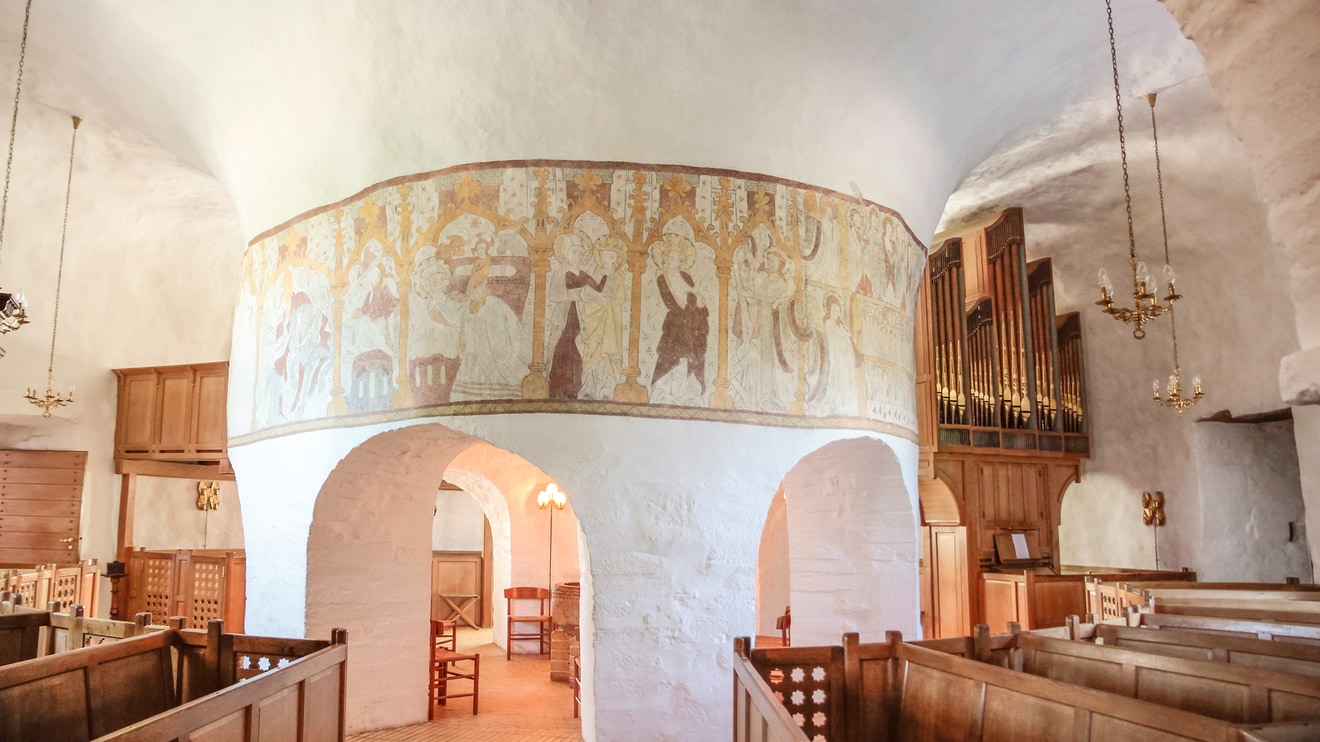
Inside, the central pillar is decorated with a continuous frieze of frescoes. These paintings date from the 14th century, were whitewashed after the Reformation, and rediscovered in 1889. They have since undergone several restorations and depict the life of Jesus in images from birth to resurrection. The altarpiece dates from around 1600; it was removed for a period and stored at the National Museum before being returned to Østerlars in 1956. It is now adorned with paintings by Paul Høm, while older inscriptions in the frame have been preserved. The baptismal font is Romanesque and probably as old as the church itself. It originally stood in Rø Church and was moved here during a major restoration in the 1950s.

Three runestones are associated with Østerlars Church: one stands outside the porch, one inside it, and one is built into the wall above the north door. The stones date from the 11th century and bear Christian runic inscriptions, reflecting the transition to Christianity on Bornholm. The church is dedicated to Saint Lawrence, one of the most widespread medieval saints, and its name is derived from his. Today, Østerlars Church functions both as an active parish church with services and ceremonies and as a significant historical and architectural landmark on Bornholm.

Østerlars Kirke